Search articles in Women in Medicine
Filter Articles
Found 97 articles
Create community by starting a Women in Medicine and Science group
- Mar 26, 2021
The menu was simple: French toast, quiche, and fresh fruit. The small group of women faculty and residents were at the home of Vidhya Prakash, an Infectious Diseases physician at Southern Illinois University (SIU) School of Medicine and they didn’t know what to expect.
Black women making strides and striving for more
- Mar 26, 2021
As the 119th President of the National Medical Association (NMA), I am the thirteenth woman to hold this position in the organization’s 124-year history. Also, I’ve been the third woman to hold this position in four years. NMA was founded because African American physicians were not allowed to join the AMA. We are the collective force for African American physicians for parity, justice and medicine.
Engage men as allies to create gender equity in health care
- Mar 26, 2021
Women are at a disadvantage in the workplace. They deal with unequal pay, sexual harassment, lack of credit for their contributions, and more. And while organizations are looking to address these issues, too many gender-inclusion initiatives focus exclusively on how women should respond, leaving men out of the equation. Such efforts reinforce the perception that these are women's issues and that men — often occupying crucial leadership roles in most organizations — don’t need to be involved.
Overcoming gender and affinity biases in the medical profession
- Mar 26, 2021
The medical profession is predominately led by men and operates in accordance with masculine norms, values, and expectations. As a result, although half of all U.S. medical school students are women, only 16% of deans, 18% of department chairs, and 25% of full professors in those schools are women (Paturel, 2019). Women are only 18% of hospital CEOs, 10% of senior authors on peer-reviewed medical papers, and 7% of editors-in-chief at prestigious medical journals (Mangurian, et al, 2018).
-
Implicit bias in medicine: Individual-level interventions may disempower vs. empower
- Mar 26, 2021
For more than two decades, institutions seeking to address gender and other inequities have used the concept of implicit bias (IB) and implicit association testing (IAT) to welcome more diversity in their ranks (FitzGerald, et al, 2019).
Find your leadership style, communicate it well
- Mar 26, 2021
“I’m the doctor, of course I’m the leader!“ Who hasn’t heard that comment — or even thought it personally? The truth is we all have a leadership style even if we’ve never thought about it.
Hack your brain to let the leader in you emerge
- Mar 26, 2021
Efforts to promote gender equity in medicine focus on training women in leadership and assertiveness skills. Once that inspiring conference ends and women return to the workplace, many of them experience a stress response and feel too uncomfortable to use the techniques they’ve learned.
Cultivating intentional success: 5 key steppingstones
- Mar 26, 2021
Have you ever hungered for success? The best type of success, the kind that is based on intention and the process of working toward goals that you define for yourself, is usually enjoyed by women who have embraced certain skills.
Build leadership capacity from within
- Mar 26, 2021
Given that I’ve worked as a business school professor teaching executives for the last 30 years, one might suppose I could make a list of qualities all leaders should demonstrate.
Adapt leadership program format, content to address needs during COVID-19 pandemic
- Mar 26, 2021
What happens when an unprecedented global crisis impacts not only the delivery of a program such as Executive Leadership in Academic Medicine® (ELAM®), but also potentially exacerbates the already vast gender disparities in medicine?
Perfect prescription for inequity: The intersection of COVID-19 and the U.S. health care system
- Mar 26, 2021
The COVID-19 pandemic is a perfect prescription for exacerbation of current, and creation of new, inequities in our health care system. When we get to the other side, the pandemic will leave unprecedented devastation in its wake, including a disproportionate toll on the aged, those with preexisting conditions, minorities, the poor, the incarcerated, essential workers, healthcare workers, and Native American populations.
Preface
- Mar 26, 2021
It is a strange time to be in medicine, and an even stranger time to be a woman in medicine. Our nation has been thrown into a pandemic for which we were unprepared where the majority of frontline essential workers are women.
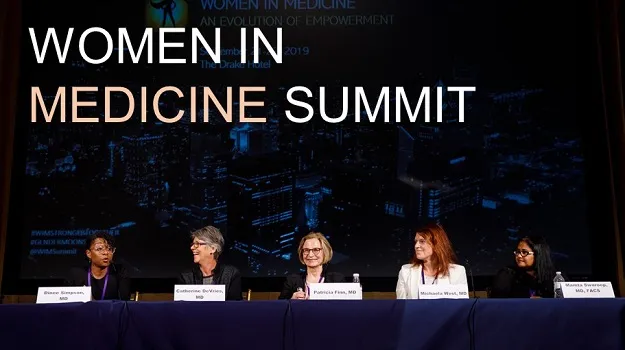
Mission statement of the Women in Medicine Summit
- Mar 26, 2021
Barriers have existed for female physicians since the first woman was accepted into medical school. In 2016, nearly 46% of medical school graduates were women, yet women physicians remain underrepresented in leadership roles, both in and out of academia.
Women in Medicine Compendium
- Sep 1, 2021
In this compendium are pieces written by invited faculty speakers from the 2019 and 2020 WIMS. These thought leaders share their expertise on the evolution of empowerment that has occurred in medicine, and ways to achieve equity in healthcare utilizing evidence, science, and authentic leadership.
Women in Medicine?
- Apr 20, 2021
The medical profession has come a long way and in 2017, women comprised of more than half the new enrollees in medical school. However, despite the increase of women in medicine, women are paid lower wages, lack opportunities for mentorship and scholarship, are promoted at a lower rate and are faced with additional barriers to publishing and receiving grants, as compared to their male counterparts.